




Insights
-

Esperia The pride of being golden pillars of kosen rufu
Dedicated to the men of the Soka family. Ginkgo trees in Japan originated in China. In Japanese, they are also designated by certain Chinese characters that literally mean “grandfather-grandson tree,” because if someone plants a ginkgo now, their grandchildren will harvest its fruits. I read this explanation a long time ago and still remember it. It seems to me that this name means: “I do not live for myself, but for the good of the generations that will come after me. I will gather all my vital strength and achieve great things!” When I look at a tall ginkgo tree, my thoughts go to the people of previous generations who planted and cared for it.
€13,00
-

Esperia A leadership revolution
A collection of encouragements from Daisaku Ikeda to Soka Gakkai leaders between 2004 and 2008."Rather than judging people as capable or incapable, it is better to look for each person's strengths. The growth of capable people depends on the leaders' determination."In the encouragements addressed to the central leaders of the Soka Gakkai in recent years, Daisaku Ikeda identifies the characteristics for expanding the kosen rufu movement in the future. The message that stands out above all others is that "what matters is the heart."
€9,00
-
Esperia An economy for the people
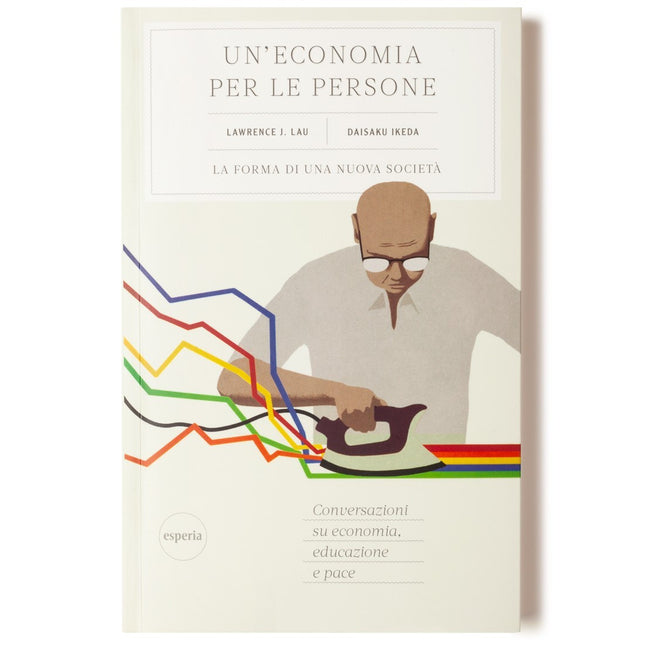
It is undeniable that economics plays a fundamental role in our lives, both individually and socially. Yet, many find the subject complex and difficult to approach, tending to avoid it. In this dialogue, economist Lawrence J. Lau and Buddhist philosopher and Soka Gakkai International President Daisaku Ikeda address the topic of economic development in modern society from a historical perspective, examining what lessons can be learned from the East Asian currency crises in 1997 and the global financial crisis in 2007-2009. Covering various subjects, the authors help readers understand the challenges globalization has imposed on economies, the importance of government regulation in markets, and the delicate issue of balancing a country's economic growth with the well-being of its entire population. These conversations, where economic aspects are not separated from people's daily lives, thus become small economics lessons. Thanks to simple and accessible language, one can begin to unravel the mystery of economics, a discipline that concerns the framework of the world we inhabit, and whose knowledge is often precluded from us by technical complexities and specialist terminology. "Economics," said economist John Kenneth Galbraith, "must serve human happiness" and "the fundamental force driving the economy is people." Daisaku Ikeda is president of Soka Gakkai International (SGI) and leader of the Buddhist movement based on the teachings of Nichiren Daishonin. An activist, philosopher, educator, and poet, Ikeda has dedicated over seventy years to spreading Buddhist humanism worldwide and building the foundations for a culture of peace. SGI, which has members in 192 countries and territories, encourages individuals to develop their inner potential and contribute as global citizens to overcome the collective challenges facing humanity. He is the founder of Soka University, with campuses in Japan and the United States, and many other institutions dedicated to researching solutions to the many crises of the contemporary era. In 1983, he was awarded the United Nations Peace Award. Lawrence J. Lau was Professor of Economics at Stanford University from 1976 to 2004, then became the sixth Vice-Chancellor of the Chinese University of Hong Kong, holding that position for seven years. He is the author of numerous publications including The Chinese Economy in the Twenty-first Century: An Econometric Approach. The challenge for policy is to balance economic growth with improving people's quality of life and ensuring that this effort is stable and sustainable. Soka Gakkai's second president, Josei Toda, often told us that individual happiness should never be sacrificed at the altar of social prosperity, but that the two aspects must advance hand in hand. I believe there is a growing urgency for economic activity to focus not only on efficiency but also on the collective interest. Daisaku Ikeda To overcome the current crisis, developed economies must focus on restarting the real economy, pursuing a path of sustainable growth and not inventing further financial tricks. We must not lose sight of the fact that the role of the financial sector is to support other sectors of the economy and that ultimately the financial sector must be directly based on the performance of the real economy. Lawrence J. Lau
€15,90
-

Esperia The eternal Soka citadel
"The dawn has broken": these were the words young Daisaku Ikeda, on his way to Kansai to confront the authorities in what later became known as the "Osaka Incident," addressed to a woman who asked for his message to the members. It was July 3, 1957. A victim of false accusations, Ikeda was imprisoned for about two weeks. When he was finally released, he rejoined his fellow believers in Osaka, declaring with conviction that victory invariably awaits those who uphold the correct Buddhist teaching, in the spirit of the non-duality of mentor and disciple. This, ultimately, is the subject of the essays included in this volume, written between 2016 and 2017, in which Daisaku Ikeda indicates the path to follow as disciples to build together a great, unassailable, and even more solid Soka citadel, and to expand an increasingly diverse network of solidarity among capable people, the Bodhisattvas of the Earth, who courageously face great struggles, based on the principle "Buddhism is inseparable from society." Some essays are particularly addressed to the Men's, Women's, and Youth Divisions, always emphasizing the strength that springs from the Soka family when it advances in unity, and the importance of nurturing the members of the Future Division, the torchbearers of justice.
€10,00
-

Esperia The Buddhism of the People
This book is rooted in the need to delve deeper into the historical events that led the Soka Gakkai to emancipate itself from the Nichiren Shoshu priesthood and what its intentions are as a lay religious association that concretely promotes peace, culture, and education worldwide. The first part of the volume offers an overview of the history of Buddhism, Nichiren Shoshu, and its patriarchs up to the present day, with particular regard to the narration of the events that recently led to the separation. The second part, on the other hand, deals with doctrinal aspects, specifically: the Gohonzon as an object of worship for the happiness of all humanity; the Gongyo ceremony, the meaning of daily practice; the Writings of Nichiren Daishonin, their composition and translations. The topics covered, also developed based on sources external to the Soka Gakkai, aim to make this text a valuable consultation tool not only for those who wish to have an exhaustive overview of the events with Nichiren Shoshu, but also for those who need to find philosophical-religious information.
€5,00
You have seen 17 out of 17 products