







Education, peace, and human rights
-

Esperia The treasures of the future: happy parents, happy children
What are the fundamental points for raising happy and serene children? The most important are the life force, wisdom, and love of the parents. I tesori del futuro (Treasures of the Future) offers all parents an essential guide to developing themselves while facing the challenges and concerns that accompany raising children. The warm advice of SGI President Daisaku Ikeda, based on a broad vision of life, provides solid guidelines for building happy families. Raising children is the oldest human activity, never ceasing since the dawn of time; at the same time, for each individual, it is always the first time. I therefore believe that if predecessors were to frankly recount their experiences, they would naturally form a chorus of support for the young and help them develop courage, wisdom, and confidence. This is the reflection from which this book originated, the fruit of a series of dialogues held with some mothers who are also leaders of the Soka Gakkai. — Daisaku Ikeda
€7,00
-

Esperia Value creation
The figure of Tsunesaburo Makiguchi, first president and founder of Soka Gakkai, is recalled in an essay that highlights his qualities as a teacher, educator, and religious leader. His works reveal the depth of his cultural preparation and great compassion for others, which he defended until his death in a culturally backward environment and within a repressive political climate.
€15,90
-
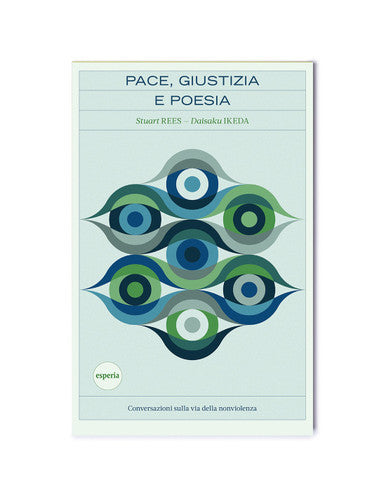
Esperia Peace, justice, and poetry
Peace is not merely the absence of war. Appeals for the ideals of “peace and justice” are often made but most of the time they end up becoming mere slogans. In the dialogue contained in this book, Stuart Rees and Daisaku Ikeda share their ideas and visions on how to create the conditions for peace through a profound awakening, a commitment to nonviolence as a “law of life,” and unwavering dedication. It is the authors' conviction that these concrete elements, and not an ideology or abstract thought, make possible a society that cultivates the dignity of all people. Finally, Rees and Ikeda emphasize how the “poetic spirit” is an excellent creative tool for imagining and realizing a future where peace and justice are one and the same. Peace, Justice, and Poetry offers a fascinating and compelling analysis of the ills afflicting our society. It also points to a nonviolent path that leads to authentic peace and provides those seeking peace with the encouragement and inspiration they need. Joseph Camilleri, Emeritus Professor of International Relations, La Trobe University, Melbourne
€15,90
-

Esperia The Buddhist Teacher of a Baptist Pastor
When some students in his religion class at Morehouse College in Atlanta told him about Daisaku Ikeda and his commitment to peace, Edward Carter Sr. – founding dean of the Martin Luther King International Chapel – had no idea who he was. He regretted that he, a disciple of Martin Luther King, a Baptist pastor dedicated to the cause of creating peace through education and action, a graduate in social sciences and a professor of religion at Morehouse College, Dr. King's alma mater, was unaware of the work of this Buddhist leader, president of Soka Gakkai International, an organization with millions of adherents worldwide engaged in a global movement for peace, culture, and education. This was the starting point that prompted Carter to deepen his knowledge of Daisaku Ikeda, leading to an important interreligious dialogue with the Buddhist leader, also achieved through several direct meetings in Tokyo. From that journey arose the urgency of this book, written by a Baptist pastor in recognition of the work done for peace by a Buddhist master. The subtitle of the book captures its essence: How My Interreligious Journey with Daisaku Ikeda Made Me a Better Christian. “There are basically two ways for a practitioner – or at least so it is in Christianity – to relate to practitioners of other religions who are as devoted to their faith as Christians are to their own. One is to convert them; the other, however, is to respectfully learn from them, without seeking uniformity but harmony.” “In my opinion, Daisaku Ikeda represents an example of what it means to be a ‘global citizen’. He has engaged in dialogue with ambassadors, anthropologists, economists, educators, historians, journalists, jurists, linguists, politicians, scientists, social engineers, sociologists, theologians, and urban planners, and also with me, completely changing my life.” The AuthorLawrence Edward Carter Sr. is a Baptist pastor, dean of the Martin Luther King Chapel at Morehouse College in Atlanta, where he is also a professor of religion. Born in Dawson, Georgia, and raised in Columbus, Ohio, he graduated from Lynchburg University in Virginia with degrees in social sciences and psychology, then continued his academic career at Boston University, where he earned Master of Divinity in theology and Master of Sacred Theology in pastoral care, as well as a doctorate in pastoral psychology and counseling. He has one son, Carter, and lives in Stonecrest, Georgia, with his wife Marva.
€16,50
-

Esperia edizioni The Light of Learning
This new collection of texts on education – many of which have already been published in a volume entitled Soka Education – is the result of a selection of works written by Daisaku Ikeda, Buddhist philosopher and founder of the Soka school system, over the course of approximately five decades. The texts, which range from educational proposals and university lectures to personal essays, not only delve into the meaning of Soka education (education for value creation), but offer a hopeful vision of the power of education to bring happiness to people and achieve world peace.
€16,00
-
Esperia The Power of Hope
A great geographical and cultural distance separates Japan from Argentina. However, Daisaku Ikeda, president of Soka Gakkai International, and Adolfo Pérez Esquivel, Nobel Peace Prize laureate, have managed to build a deep friendship, based on common affinities and values, in defense of human rights without borders or discrimination. Ikeda and Pérez Esquivel engage in a dialogue on topics such as solidarity, the wisdom of peoples and women, resistance to totalitarianism, the search for effective action, and the valuing of diverse cultures, with the aim of finding a path to peace. Through words and examples from their lives, the authors seek to convey to young people the value of energetic and passionate commitment to peace, hope, and justice for their peoples and for all the peoples of the Earth.
€13,00
-

Esperia A New Humanism
A collection of lectures by D. Ikeda at renowned universities around the world.This volume collects the lectures that Daisaku Ikeda delivered at important universities worldwide from 1975 to 1995: fragments of Buddhist wisdom that propose a more humane society, one that values the individual and their infinite potential in a world without borders. Always striving to grasp the commonalities between different cultures while simultaneously extolling the unique characteristics of each people, the author seeks to create bonds, bridges of friendship and understanding in a constant effort to overcome the distrust that divides the West from the East, one nation from another. He does not do so by insisting on his own position, but by exploring the legacy bequeathed to humanity by great thinkers. Borrowing the words of figures such as Tolstoy, Gandhi, Leonardo da Vinci, Pascal, or the sages of ancient China, Ikeda is able to speak the same language as the most disparate listeners, a language common to the human heart.
€16,50
-
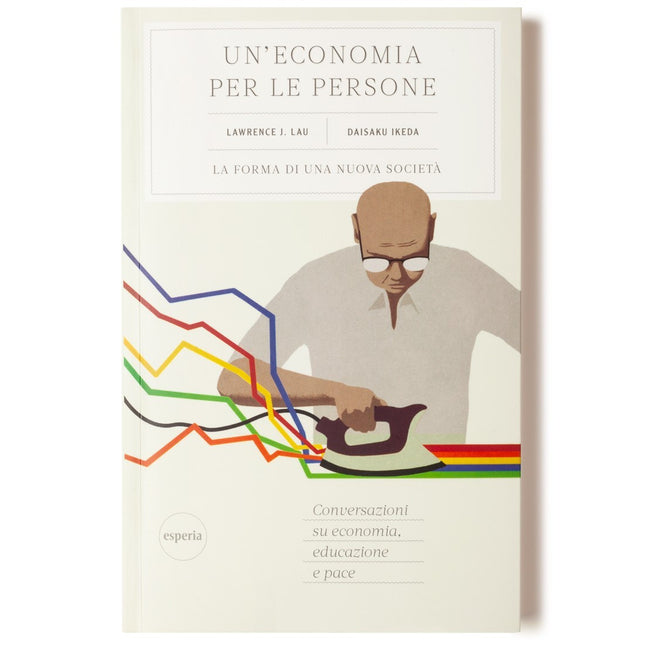
Esperia An economy for the people
It is undeniable that economics plays a fundamental role in our lives, both individually and socially. Yet, many find the subject complex and difficult to approach, tending to avoid it. In this dialogue, economist Lawrence J. Lau and Buddhist philosopher and Soka Gakkai International President Daisaku Ikeda address the topic of economic development in modern society from a historical perspective, examining what lessons can be learned from the East Asian currency crises in 1997 and the global financial crisis in 2007-2009. Covering various subjects, the authors help readers understand the challenges globalization has imposed on economies, the importance of government regulation in markets, and the delicate issue of balancing a country's economic growth with the well-being of its entire population. These conversations, where economic aspects are not separated from people's daily lives, thus become small economics lessons. Thanks to simple and accessible language, one can begin to unravel the mystery of economics, a discipline that concerns the framework of the world we inhabit, and whose knowledge is often precluded from us by technical complexities and specialist terminology. "Economics," said economist John Kenneth Galbraith, "must serve human happiness" and "the fundamental force driving the economy is people." Daisaku Ikeda is president of Soka Gakkai International (SGI) and leader of the Buddhist movement based on the teachings of Nichiren Daishonin. An activist, philosopher, educator, and poet, Ikeda has dedicated over seventy years to spreading Buddhist humanism worldwide and building the foundations for a culture of peace. SGI, which has members in 192 countries and territories, encourages individuals to develop their inner potential and contribute as global citizens to overcome the collective challenges facing humanity. He is the founder of Soka University, with campuses in Japan and the United States, and many other institutions dedicated to researching solutions to the many crises of the contemporary era. In 1983, he was awarded the United Nations Peace Award. Lawrence J. Lau was Professor of Economics at Stanford University from 1976 to 2004, then became the sixth Vice-Chancellor of the Chinese University of Hong Kong, holding that position for seven years. He is the author of numerous publications including The Chinese Economy in the Twenty-first Century: An Econometric Approach. The challenge for policy is to balance economic growth with improving people's quality of life and ensuring that this effort is stable and sustainable. Soka Gakkai's second president, Josei Toda, often told us that individual happiness should never be sacrificed at the altar of social prosperity, but that the two aspects must advance hand in hand. I believe there is a growing urgency for economic activity to focus not only on efficiency but also on the collective interest. Daisaku Ikeda To overcome the current crisis, developed economies must focus on restarting the real economy, pursuing a path of sustainable growth and not inventing further financial tricks. We must not lose sight of the fact that the role of the financial sector is to support other sectors of the economy and that ultimately the financial sector must be directly based on the performance of the real economy. Lawrence J. Lau
€15,90
-
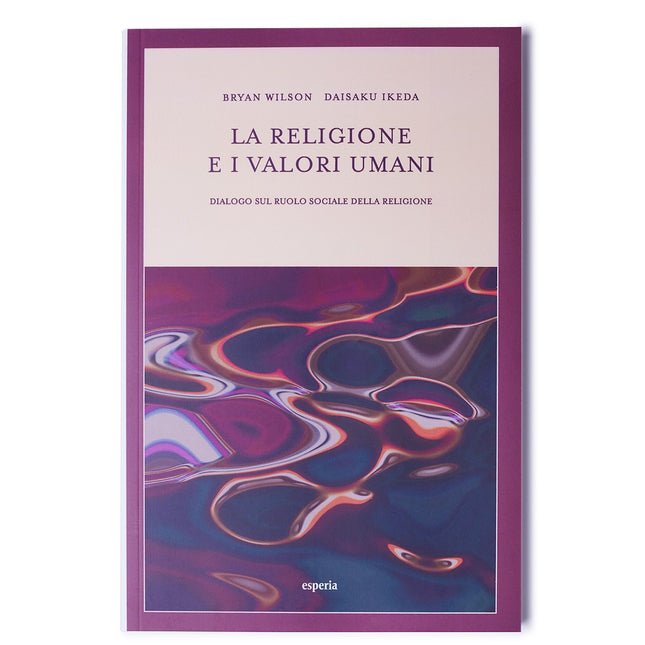
Esperia Religion and Human Values
A Japanese Buddhist leader, Daisaku Ikeda, and a British sociologist, Brian Wilson, discuss the role of religion and its connections to the main ethical and social problems of our time. Their dialogue focuses on the role and importance of religion and religious sentiment for both the individual and society as a whole. The positive potential of religious doctrines for the inner development of human beings and the proper functioning of society emerges. However, the authors do not fail to highlight the risks associated with the institutionalization of religious movements and the use of religion as a tool for control and power.
€15,90
-

Esperia Soka Education
Peace, culture, and education are the three founding elements of the activities promoted by Soka Gakkai International worldwide. In this volume, Daisaku Ikeda examines the strengths of the pedagogical thought of Tsunesaburo Makiguchi, a pioneer of creative education, and develops the theme of fostering global consciousness in young people. Dialogue and exchange represent valuable opportunities for enrichment for every person, but these must be earned through an effort of spiritual growth. In this sense, creative education and global citizenship constitute solid reference points for the harmonious development of each individual's personality.
€11,00