






Essays
-

Esperia Value creation
The figure of Tsunesaburo Makiguchi, first president and founder of Soka Gakkai, is recalled in an essay that highlights his qualities as a teacher, educator, and religious leader. His works reveal the depth of his cultural preparation and great compassion for others, which he defended until his death in a culturally backward environment and within a repressive political climate.
€15,90
-

Esperia edizioni The Light of Learning
This new collection of texts on education – many of which have already been published in a volume entitled Soka Education – is the result of a selection of works written by Daisaku Ikeda, Buddhist philosopher and founder of the Soka school system, over the course of approximately five decades. The texts, which range from educational proposals and university lectures to personal essays, not only delve into the meaning of Soka education (education for value creation), but offer a hopeful vision of the power of education to bring happiness to people and achieve world peace.
€16,00
-

Esperia Culture, Art and Nature
The text addresses themes of respect for nature, understanding artistic phenomena, and the importance of reading as true nourishment for the mind. Reading is a dialogue with characters, intellectuals, masters of thought distant in time or space, and even with past cultures. The author doesn't just offer food for thought but also provides practical advice on how to improve one's reading ability. Discussing the view of nature, he introduces the Buddhist concept of "dependent origination," reiterating that we are all connected to each other, as well as to every other phenomenon in the universe: "Life is a chain. Everything is linked. When one link in the chain deteriorates, all others will be affected too. We should consider the environment as our mother, Mother Earth."
€6,00
-

Esperia A leadership revolution
A collection of encouragements from Daisaku Ikeda to Soka Gakkai leaders between 2004 and 2008."Rather than judging people as capable or incapable, it is better to look for each person's strengths. The growth of capable people depends on the leaders' determination."In the encouragements addressed to the central leaders of the Soka Gakkai in recent years, Daisaku Ikeda identifies the characteristics for expanding the kosen rufu movement in the future. The message that stands out above all others is that "what matters is the heart."
€9,00
-
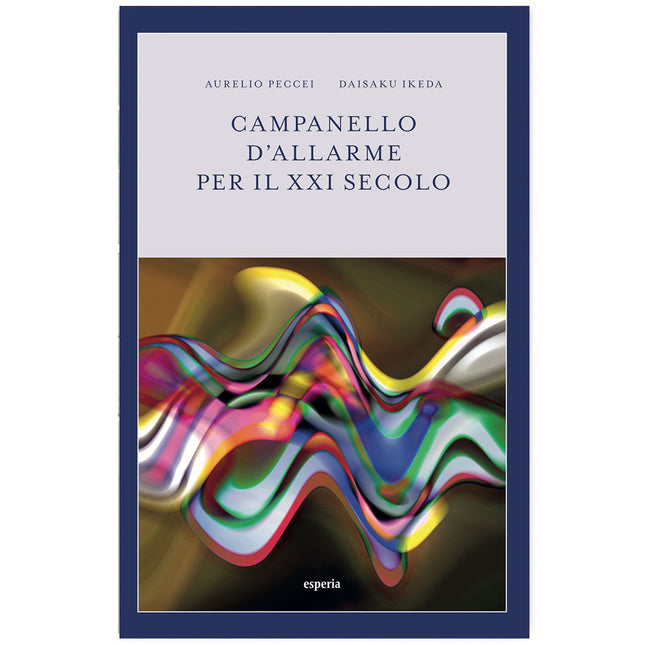
Esperia Wake-up call for the 21st century
Rebuilding a healthy and harmonious relationship with Nature, addressing the issue of population growth, coming to terms with problems related to energy resources, and ending conflicts that destroy entire peoples and ecosystems. These are topics that over the last thirty years have been addressed repeatedly from many points of view, and in Aurelio Peccei they found a true forerunner. Founder of the Club of Rome and promoter of the famous report entitled The Limits to Growth, he addressed many issues together with SGI President Daisaku Ikeda that still demand our attention today, even with greater urgency. The task that the two authors undertook was burdensome, especially due to the obvious difficulty of "singing out of tune," that is, trying to stimulate a major international debate on topics that few were willing to question. But it is precisely in this that the caliber of great protagonists is recognized, as they become bearers of messages that transcend the present moment and push us to build a clear vision of the future.
€16,00
-
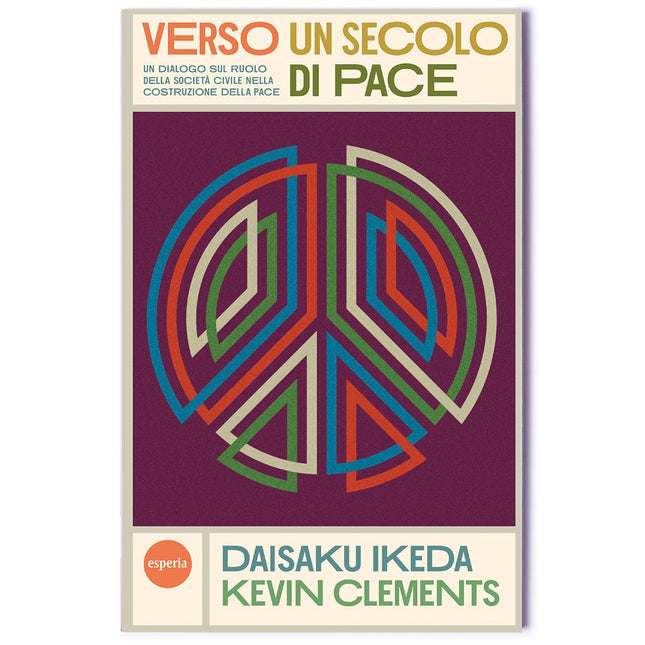
Esperia Towards a century of peace
A dialogue on the role of civil society in peacebuilding. In this book, Kevin P. Clements, one of the world's leading experts in conflict resolution studies, engages in a dialogue with philosopher and Buddhist leader Daisaku Ikeda on the topic of peace and the role of civil society in this field. In their conversations, which are anything but academic or theoretical, and are based on the concrete experiences of the two authors who have dedicated their lives to peacebuilding, they provide a wealth of examples in which the actions of ordinary people have transformed social and political situations. Unusual aspects of the peacebuilding process emerge, which are not only within the reach of diplomats and statesmen but of every person. For example, the importance of "imagining" what the world we want to live in would be like, or the importance of "conviviality," meaning the pleasure of conversing with people in informal settings, such as over a good meal, which has surprisingly proven crucial for many negotiations. It is an invitation to everyone, and especially to young people, to become aware of their power, because, as Daisaku Ikeda states, «lack of trust in the government is observed in every country, but if young people lose interest in politics, society will have no future.» And to young people, but not only them, is addressed the appeal of the two authors to take the risk of stepping out of their comfort zone to open up to the diversity of others. The conviction of these two great thinkers is that the path to peace will only open when young people work together for a common purpose, united to solve problems beyond national borders. «Peace is not something abstract or separate from daily life. We can all do something for peace right where we are now.» Daisaku Ikeda «Fear and distrust do not help change. The only way to create a just and peaceful world is to act with the confidence of wanting a better future.»Kevin Clements «Sincerely listening to the problems of a single person, right where we are now, encouraging them and nurturing hope in their heart is a humble and tenacious effort; perhaps it won't be news that travels the world, perhaps it won't enter the annals of history, but every person who feels a new hope burning in their heart will rediscover the strength to live, and your action will have been precious for their life. This is the basis of a solid peace movement deeply rooted in people's hearts. It is my fervent wish that young people, first and foremost, continue to build a network of people who spread joy and revitalization, thereby creating a magnificent ray of light for the twenty-first century.»Daisaku Ikeda
€15,90
-

Esperia Youth and Nichiren Daishonin's Writings
Daisaku Ikeda's encouragements to young people, based on the writings of Nichiren Daishonin. "We live in times of rapid change, which require the active participation of young people, with the courage, vitality and foresight that characterise them. The time has come to step forward and take responsibility for our magnificent movement for the realization of worldwide kosen rufu." These are the words with which the series of dialogues that SGI President Daisaku Ikeda held with youth division leaders, thinking about the development of the kosen rufu movement, begins. Various salient passages from Nichiren Daishonin's writings are examined, highlighting the aspects that refer to the fundamentals of Buddhist teaching and emphasizing their relevance to contemporary reality.
€11,00
-
Esperia The Power of Hope
A great geographical and cultural distance separates Japan from Argentina. However, Daisaku Ikeda, president of Soka Gakkai International, and Adolfo Pérez Esquivel, Nobel Peace Prize laureate, have managed to build a deep friendship, based on common affinities and values, in defense of human rights without borders or discrimination. Ikeda and Pérez Esquivel engage in a dialogue on topics such as solidarity, the wisdom of peoples and women, resistance to totalitarianism, the search for effective action, and the valuing of diverse cultures, with the aim of finding a path to peace. Through words and examples from their lives, the authors seek to convey to young people the value of energetic and passionate commitment to peace, hope, and justice for their peoples and for all the peoples of the Earth.
€13,00
-

Esperia The Ikeda Kayo Kai Vow
Daisaku Ikeda's Guidance for the young women of the Kayo-kai group.
€5,00
-

Esperia Buddhism, the first millennium
The book discusses the development of Buddhism after the death of its founder Shakyamuni. Starting from the first council, organized by Shakyamuni's direct disciples, which brought order to the complex system of the Buddha's teachings, up to the birth of the Mahayana movement, whose origins remain poorly defined. Daisaku Ikeda examines the sparse historical information that has reached us and interprets it with his characteristic originality and intuition. He expounds the essential principles of the Lotus Sutra, the fundamental scripture of the Great Vehicle, and retraces the events of some of the protagonists in the history of Buddhism: King Ashoka and the philosophers Nagarjuna and Vasubandhu, who contributed to its affirmation as one of the major world religions.
€11,00
-

Esperia The Life of the Buddha
An interpretive biography of the historical Buddha, Shakyamuni. Daisaku Ikeda, a contemporary Buddhist leader and thinker, attempts to trace, using the scarce biographical information available about Gautama Siddhartha, known as Shakyamuni or the Buddha, the motivations that led a man who had every earthly wealth and privilege at his disposal to abandon palaces, his princely title, wife, and son. He likely did so in reaction to the discovery of the fundamental sufferings of life, which spare no one, not even those who enjoy a privileged existence. Ikeda retraces the steps of the young man in search of the enlightenment that can free human beings from every bond of suffering, engaging in a quest based on sparse sources and his own experience as a Buddhist practitioner. Can what drove Gautama Siddhartha almost three thousand years ago to undertake a arduous struggle to overcome the impermanence of life and find the supreme happiness represented by "awakening," or Buddhahood, still be valid today? Can his message, which has changed the lives of millions of people over the centuries throughout the East, also inspire the West? The author, and we with him, believes it can and helps us understand the essence of the "Enlightened One's" illumination. The original title of the work, My View of Shakyamuni, suggests the spirit with which the author approached the historical Buddha, who lived in India approximately twenty-five centuries ago. Indeed, there is very little data about his life, and the only sources are texts transmitted for centuries solely in oral form. Reconstructing the life of the "Sage of the Shakyas" therefore means trying to go far beyond what the news and hagiographic accounts have handed down to us, and making a considerable effort to interpret the many important choices Shakyamuni made throughout his life. Ikeda undertakes this journey based on his own experience as a contemporary religious leader, and it is precisely by virtue of this role that he guides us to understand the deepest meaning of the "Enlightened One's" illumination.
€11,00
-

Esperia A New Humanism
A collection of lectures by D. Ikeda at renowned universities around the world.This volume collects the lectures that Daisaku Ikeda delivered at important universities worldwide from 1975 to 1995: fragments of Buddhist wisdom that propose a more humane society, one that values the individual and their infinite potential in a world without borders. Always striving to grasp the commonalities between different cultures while simultaneously extolling the unique characteristics of each people, the author seeks to create bonds, bridges of friendship and understanding in a constant effort to overcome the distrust that divides the West from the East, one nation from another. He does not do so by insisting on his own position, but by exploring the legacy bequeathed to humanity by great thinkers. Borrowing the words of figures such as Tolstoy, Gandhi, Leonardo da Vinci, Pascal, or the sages of ancient China, Ikeda is able to speak the same language as the most disparate listeners, a language common to the human heart.
€16,50
You have seen 48 out of 56 products