




Books and magazines
-

IBISG 951 New Renaissance - APRIL 2026
The first publication of the Italian Soka Gakkai Buddhist Institute, founded in February 1982, will have a new print version of 44 pages (compared to the current 32 of NR Selezione) and will adopt the current format of Buddhism and Society. It will therefore be a totally renewed magazine, with a greater number of pages and variety of content. It will be published every month and will present everything necessary to deepen faith, practice and the study of Buddhism, and to carry out Soka Gakkai activities. The lesson for the monthly study, until now in Buddhism and Society, will also be published in Il Nuovo Rinascimento. As Daisaku Ikeda writes: "Our magazines have the role of transforming despair into hope, pain into joy, the sense of powerlessness into courage, to move from 'a life in which one cries for one's karma' to 'a life in which one lives to fulfill one's mission' by revitalizing oneself and others."
€4,00
-
€4,50
-
€4,50
-
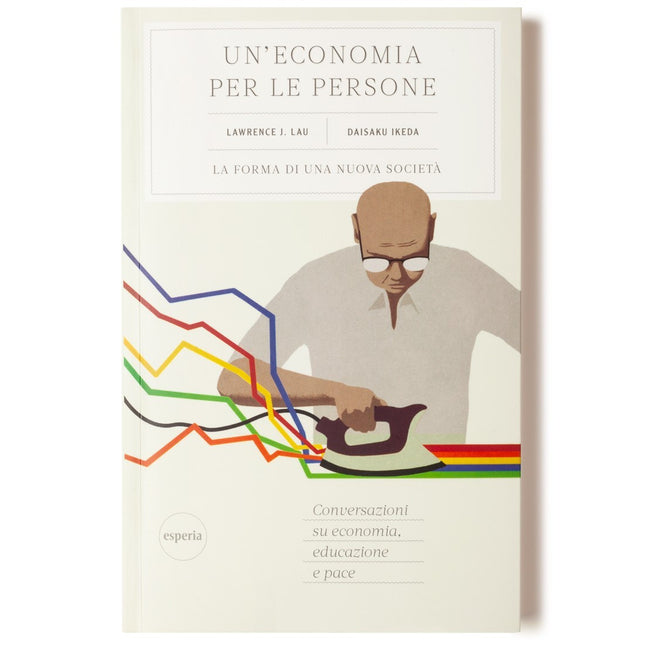
Esperia An economy for the people
It is undeniable that economics plays a fundamental role in our lives, both individually and socially. Yet, many find the subject complex and difficult to approach, tending to avoid it. In this dialogue, economist Lawrence J. Lau and Buddhist philosopher and Soka Gakkai International President Daisaku Ikeda address the topic of economic development in modern society from a historical perspective, examining what lessons can be learned from the East Asian currency crises in 1997 and the global financial crisis in 2007-2009. Covering various subjects, the authors help readers understand the challenges globalization has imposed on economies, the importance of government regulation in markets, and the delicate issue of balancing a country's economic growth with the well-being of its entire population. These conversations, where economic aspects are not separated from people's daily lives, thus become small economics lessons. Thanks to simple and accessible language, one can begin to unravel the mystery of economics, a discipline that concerns the framework of the world we inhabit, and whose knowledge is often precluded from us by technical complexities and specialist terminology. "Economics," said economist John Kenneth Galbraith, "must serve human happiness" and "the fundamental force driving the economy is people." Daisaku Ikeda is president of Soka Gakkai International (SGI) and leader of the Buddhist movement based on the teachings of Nichiren Daishonin. An activist, philosopher, educator, and poet, Ikeda has dedicated over seventy years to spreading Buddhist humanism worldwide and building the foundations for a culture of peace. SGI, which has members in 192 countries and territories, encourages individuals to develop their inner potential and contribute as global citizens to overcome the collective challenges facing humanity. He is the founder of Soka University, with campuses in Japan and the United States, and many other institutions dedicated to researching solutions to the many crises of the contemporary era. In 1983, he was awarded the United Nations Peace Award. Lawrence J. Lau was Professor of Economics at Stanford University from 1976 to 2004, then became the sixth Vice-Chancellor of the Chinese University of Hong Kong, holding that position for seven years. He is the author of numerous publications including The Chinese Economy in the Twenty-first Century: An Econometric Approach. The challenge for policy is to balance economic growth with improving people's quality of life and ensuring that this effort is stable and sustainable. Soka Gakkai's second president, Josei Toda, often told us that individual happiness should never be sacrificed at the altar of social prosperity, but that the two aspects must advance hand in hand. I believe there is a growing urgency for economic activity to focus not only on efficiency but also on the collective interest. Daisaku Ikeda To overcome the current crisis, developed economies must focus on restarting the real economy, pursuing a path of sustainable growth and not inventing further financial tricks. We must not lose sight of the fact that the role of the financial sector is to support other sectors of the economy and that ultimately the financial sector must be directly based on the performance of the real economy. Lawrence J. Lau
€15,90
-

Esperia Protagonists of the New Era
Daisaku Ikeda's Guidance for Future Division Girls and Boys.
€4,00
-

IBISG 950 New Renaissance with B&S insert - MARCH 2026
NEW EDITORIAL PROJECT Il Nuovo Rinascimento, 44 pages, monthly, ilnuovorinascimento.orgBuddismo e Società, 36 pages, bimonthly, buddismoesocieta.org The first publication of the Italian Buddhist Institute Soka Gakkai, founded in February 1982, will have a new print version of 44 pages (compared to the current 32 of NR Selezione) and will adopt the current format of Buddismo e società. It will therefore be a totally revamped magazine, with a greater number of pages and variety of content, it will be published every month and will present everything necessary to deepen faith, practice and study of Buddhism, and to carry out the activities of the Soka Gakkai. The lesson for the monthly study, until now in Buddismo e società, will also be published in Il Nuovo Rinascimento In 2026, its fortieth anniversary will be celebrated, in its print version it will be 36 pages and will be published every two months. Its specials, interviews and columns will thus be able to be increasingly accurate and entirely dedicated to exploring social and cultural themes in the light of Buddhism, aiming to spread a humanistic and hopeful vision in society. At the same time, it will be an even more effective tool to present the Soka Gakkai and its initiatives for peace, culture and education, including those related to projects supported by the 8x1000 funds and the Be The Hope Foundation. As Daisaku Ikeda writes: "Our magazines have the role of transforming despair into hope, pain into joy, a sense of powerlessness into courage, to move from 'a life in which one cries for one's karma' to 'a life in which one lives to fulfill one's mission' by revitalizing oneself and others."
€6,00
-

IBISG 950 New Renaissance with B&S insert - MARCH 2026
NEW EDITORIAL PROJECT Il Nuovo Rinascimento, 44 pages, monthly, ilnuovorinascimento.orgBuddismo e Società, 36 pages, bimonthly, buddismoesocieta.org The first publication of the Italian Buddhist Institute Soka Gakkai, founded in February 1982, will have a new print version of 44 pages (compared to the current 32 of NR Selezione) and will adopt the current format of Buddismo e società. It will therefore be a totally revamped magazine, with a greater number of pages and variety of content, it will be published every month and will present everything necessary to deepen faith, practice and study of Buddhism, and to carry out the activities of the Soka Gakkai. The lesson for the monthly study, until now in Buddismo e società, will also be published in Il Nuovo Rinascimento In 2026, its fortieth anniversary will be celebrated, in its print version it will be 36 pages and will be published every two months. Its specials, interviews and columns will thus be able to be increasingly accurate and entirely dedicated to exploring social and cultural themes in the light of Buddhism, aiming to spread a humanistic and hopeful vision in society. At the same time, it will be an even more effective tool to present the Soka Gakkai and its initiatives for peace, culture and education, including those related to projects supported by the 8x1000 funds and the Be The Hope Foundation. As Daisaku Ikeda writes: "Our magazines have the role of transforming despair into hope, pain into joy, a sense of powerlessness into courage, to move from 'a life in which one cries for one's karma' to 'a life in which one lives to fulfill one's mission' by revitalizing oneself and others."
€6,00
-

€4,50
-
€4,50
-
€4,50
-

Esperia edizioni The Eternal City
The novel opens with the Jubilee of 1900 in Rome, at the height of the dispute between the Vatican and the Italian State over the temporal power of the Church. This context is intertwined with the social demands of the era, animated by a Christian socialism that Caine himself was steeped in. Davide Rossi is a Left-wing deputy who fights for the people and opposes a corrupt prime minister, who will try to prevent the culmination of the love story between Rossi and Donna Roma Volonna. Caine spent a long time in Rome, visiting every place depicted in the novel; his descriptions of Regina Coeli, the Vatican and its ceremonies, the city's fashionable places and its squares teeming with ordinary people, convey the atmosphere of the time. The book is imbued with a religious sense of life and the characters, even the most abject ones, are described compassionately, like a true investigator of the human soul. Reading this text more than a century after its release, one cannot help but be struck by the author's visionary ability: he foresaw for Italy, albeit in terms of "fictional politics", the dictatorship, the abdication of the monarchy, and the birth of the Republic, forty years in advance. Thomas Henry Hall Caine (1853-1931) wrote about fifteen novels, veritable best-sellers, which earned him the title of "Sir" in 1917. The Manxman of 1894 is the most well-known of his works, thanks to A. Hitchcock's film adaptation in 1929. The Christian (1897) was the first book to sell a million copies in England. Pietro Mascagni set the theatrical version of The Eternal City to music in 1902.
€19,90
-
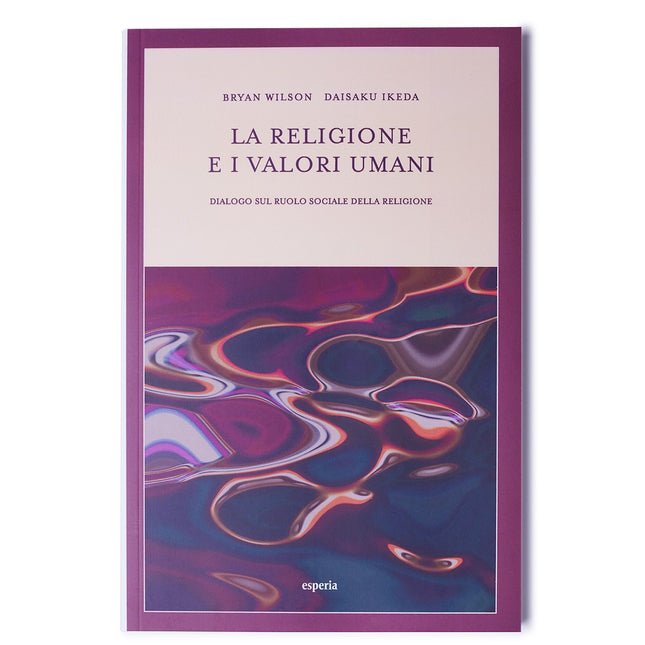
Esperia Religion and Human Values
A Japanese Buddhist leader, Daisaku Ikeda, and a British sociologist, Brian Wilson, discuss the role of religion and its connections to the main ethical and social problems of our time. Their dialogue focuses on the role and importance of religion and religious sentiment for both the individual and society as a whole. The positive potential of religious doctrines for the inner development of human beings and the proper functioning of society emerges. However, the authors do not fail to highlight the risks associated with the institutionalization of religious movements and the use of religion as a tool for control and power.
€15,90
You have seen 120 out of 127 products