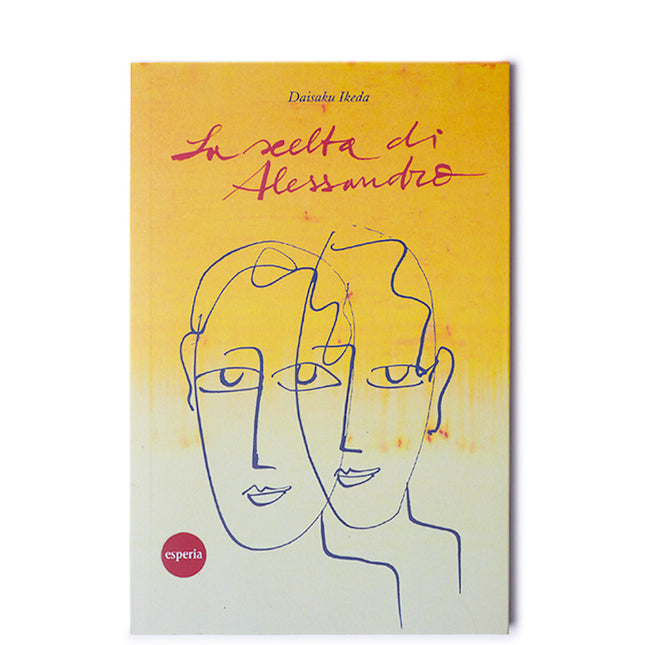
A novel by Daisaku Ikeda on the theme of friendship.333 BC. Alexander the Great, on his conquest of the East, contracts a severe illness. No one among the wise men in his retinue can find a cure to save him from death. But in the nocturnal quiet of the camp, as the disease slowly consumes his body, a tormenting doubt tears at his soul. Is the potion prepared for him by Philip, his loyal childhood friend and personal physician, a medicine or a poison? As swift as the wind, sent by one of his generals, a messenger on horseback arrives to deliver the letter containing the answer: Philip is a traitor. The young and invincible king will thus have to wonder whether to trust the messenger and disown his lifelong friend, or bring the cup to his lips and risk his life. The classical world meets Buddhist teachings and offers Master Ikeda the opportunity to celebrate, in a compelling and precious book, the value of loyalty and friendship.
True friendship is not based on calculation. Gold and wealth cannot buy it. It makes us better: it brings out our qualities, helps us make others happy, and while we strive to do so, it gives us joy. Therefore, a friend is like a second self; in friendship two people become one, and a bond of this kind can be defined as life itself.
The first publication of the Italian Soka Gakkai Buddhist Institute, founded in February 1982, will have a new print version of 44 pages (compared to the current 32 of NR Selezione) and will adopt the current format of Buddhism and Society. It will therefore be a totally renewed magazine, with a greater number of pages and variety of content. It will be published every month and will present everything necessary to deepen faith, practice and the study of Buddhism, and to carry out Soka Gakkai activities. The lesson for the monthly study, until now in Buddhism and Society, will also be published in Il Nuovo Rinascimento.
As Daisaku Ikeda writes:
"Our magazines have the role of transforming despair into hope, pain into joy, the sense of powerlessness into courage, to move from 'a life in which one cries for one's karma' to 'a life in which one lives to fulfill one's mission' by revitalizing oneself and others."
"The dawn has broken": these were the words young Daisaku Ikeda, on his way to Kansai to confront the authorities in what later became known as the "Osaka Incident," addressed to a woman who asked for his message to the members. It was July 3, 1957. A victim of false accusations, Ikeda was imprisoned for about two weeks. When he was finally released, he rejoined his fellow believers in Osaka, declaring with conviction that victory invariably awaits those who uphold the correct Buddhist teaching, in the spirit of the non-duality of mentor and disciple. This, ultimately, is the subject of the essays included in this volume, written between 2016 and 2017, in which Daisaku Ikeda indicates the path to follow as disciples to build together a great, unassailable, and even more solid Soka citadel, and to expand an increasingly diverse network of solidarity among capable people, the Bodhisattvas of the Earth, who courageously face great struggles, based on the principle "Buddhism is inseparable from society." Some essays are particularly addressed to the Men's, Women's, and Youth Divisions, always emphasizing the strength that springs from the Soka family when it advances in unity, and the importance of nurturing the members of the Future Division, the torchbearers of justice.
Peace, culture, and education are the three founding elements of the activities promoted by Soka Gakkai International worldwide. In this volume, Daisaku Ikeda examines the strengths of the pedagogical thought of Tsunesaburo Makiguchi, a pioneer of creative education, and develops the theme of fostering global consciousness in young people. Dialogue and exchange represent valuable opportunities for enrichment for every person, but these must be earned through an effort of spiritual growth. In this sense, creative education and global citizenship constitute solid reference points for the harmonious development of each individual's personality.
This book is rooted in the need to delve deeper into the historical events that led the Soka Gakkai to emancipate itself from the Nichiren Shoshu priesthood and what its intentions are as a lay religious association that concretely promotes peace, culture, and education worldwide. The first part of the volume offers an overview of the history of Buddhism, Nichiren Shoshu, and its patriarchs up to the present day, with particular regard to the narration of the events that recently led to the separation. The second part, on the other hand, deals with doctrinal aspects, specifically: the Gohonzon as an object of worship for the happiness of all humanity; the Gongyo ceremony, the meaning of daily practice; the Writings of Nichiren Daishonin, their composition and translations. The topics covered, also developed based on sources external to the Soka Gakkai, aim to make this text a valuable consultation tool not only for those who wish to have an exhaustive overview of the events with Nichiren Shoshu, but also for those who need to find philosophical-religious information.