



Books and magazines
-
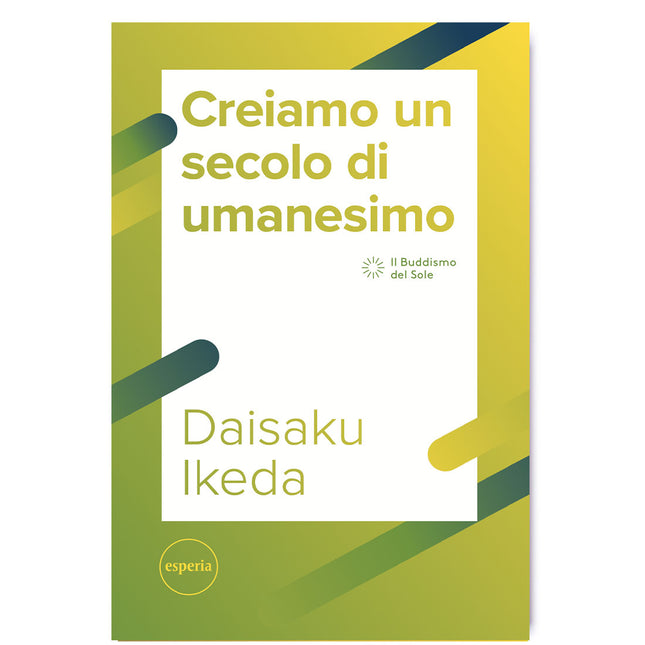
Esperia Let's create a century of humanism
The book explores some concepts of Nichiren Daishonin's Buddhism, with particular emphasis on the importance of respect for the dignity of every human being, compassion, and active commitment to one's own and others' happiness. Through an analysis of the figure of Bodhisattva Never Disparaging and the kosen rufu movement as a whole, Master Ikeda invites us to transform challenges into opportunities, to contribute to building a peaceful and just society, and to cultivate a solid and unshakeable faith. "Nichiren Buddhism exists for the well-being of all people. That is why we should behave like Bodhisattva Never Disparaging, respecting each one of them and wishing for them to shine to their fullest. One's happiness is not built upon the misfortunes of others." Daisaku Ikeda
€7,90
-

Esperia The New Human Revolution, Vol. 28
This volume describes the events that took place in 1978. On June 19 of that year, the Soka Gakkai received from the priesthood a list of over thirty doctrinal questions, formulated on the basis of various issues raised by the priests, who accused the Soka Gakkai of deviating from the school's teachings. Using the authority derived from their role, the priests began to pressure members to leave the organization and associate directly with their temples as "danto" members, or lay affiliates of the temple. Among their strategies was to threaten members, claiming that if they remained with the Soka Gakkai, they would not be able to attain Buddhahood. Shin'ichi Yamamoto devoted all his efforts to protecting the members from these vile attacks and to trying to maintain unity between the clergy and the laity. Meanwhile, the Soka Gakkai president was always committed to revitalizing the organization's activities: throughout the year, Shin'ichi visited various prefectures of Japan to offer encouragement in faith; in June, he participated in the leaders' meeting for the twenty-first anniversary of the Student Division, during which he reaffirmed his unlimited expectations for students and for what they could achieve in the 21st century; Shin'ichi also used every spare moment between his many commitments to write the lyrics for various songs. Finally, in the first days of October 1978, President Yamamoto participated in the first general meeting of the Remote Islands Department, offering his encouragement to the many members who had come to the headquarters after long and challenging journeys from numerous distant islands of Japan. "Our growth in faith is reflected in our humanity and clearly manifested in our words and actions imbued with deep care for others. It is this humanity that will determine the future of kosen rufu." Daisaku Ikeda
€20,00
-

Esperia edizioni The journey of mentor and disciple for worldwide kosen-rufu
The book's main topic is the principle of the non-duality of mentor and disciple in Nichiren Buddhism, highlighting the importance for kosen-rufu of transmitting this bond through the generations. Daisaku Ikeda retraces his journey to realize the vision of his mentor, the second president of the Soka Gakkai Josei Toda, emphasizing the value of perseverance, courage, compassion, and trust in youth.
€7,90
-

Esperia Attaining Buddhahood in This Lifetime
Daisaku Ikeda's lecture on Nichiren Daishonin's writing. What constitutes a truly meaningful existence? What is true happiness? Nichiren Daishonin's Buddhism is a teaching full of hope that allows us to forge a state of supreme happiness. Daisaku Ikeda's lecture on this very important writing of the Daishonin is a milestone, an essential text for understanding the scope of Buddhism.
€7,00
-

Esperia The New Human Revolution, Vol. 30
The autobiographical novel by Daisaku Ikeda, president of the SGI. This volume, which concludes The New Human Revolution, describes numerous highlights in the history of kosen-rufu: from the events that took place in the early months of 1979 when Shin’ichi Yamamoto, after resigning from his position as Soka Gakkai president due to the treacherous schemes orchestrated by the Nichiren Shoshu priesthood, stood firm like an unshakeable mountain in the face of these difficulties, initiating a grand new phase of the kosen-rufu movement worldwide; to his fifth visit to China in 1980 and to North America, South America, and the Soviet Union the following year; from his trip to Italy in 1981, during which Shin’ichi Yamamoto particularly dedicated himself to encouraging and nurturing young people, to numerous activities in various areas of Japan. In the concluding chapter, titled The Vow, we finally find a description of the events that led to the excommunication of the Soka Gakkai by Nichiren Shoshu. November 28, 1991, the day of the excommunication, is defined by Shin’ichi as “a historic date, the day of our spiritual independence.” It is also the moment when the Soka Gakkai definitively takes flight toward the twenty-first century as a world religion. The chapter – and the entire novel – concludes with a description of the center leaders' meeting on November 12, 2001, during which Shin’ichi made an impassioned appeal to young people, the Bodhisattvas of the Earth who live for the great vow of kosen-rufu, entrusting them with the future of the Soka movement worldwide. In his heart, Shin’ichi appealed to the youth: “Let’s move forward together! Let’s fight as long as we live. Let’s advance with confidence and vigor, making the sound of the second series of the Seven Bells resound loudly.” Within himself, Shin’ichi clearly envisioned the Soka youth, like majestic young eagles, soaring in the light of the dawn of the third millennium. He saw them flying high, in an uninterrupted flow, into the immense skies of the world.
€20,00
-

Esperia Prayer and action
Ikeda dialogues with young people on the theme of prayer and action. What power is unleashed from chanting daimoku? Is it really true that if we address our prayers to the Gohonzon they will be fulfilled? Why does an organization like the Soka Gakkai exist? Daisaku Ikeda answers these questions posed by young people with concrete and immediately understandable examples. His words help readers understand some cornerstones of Buddhist faith, in both the aspects of personal practice and the commitment to supporting the kosen rufu movement.«President Toda – he states – used the expression "absolute faith" to describe the condition in which one experiences that life, in itself, is pure joy. If one progresses in faith without ever stopping, one will surely be able to experience such a condition.»
€6,00
-

Esperia Master and Disciple
The Gosho and the Non-Duality of Mentor and Disciple. Nichiren explains multiple times in the Gosho that we can fully blossom our humanity only thanks to a mentor. Even in European culture, a well-known aphorism states that we are "dwarfs on the shoulders of giants," meaning that however limited we may be, we can always see a little further thanks to the achievements of those who lived before us. But in Nichiren Daishonin's Buddhism, the mentor-disciple relationship is much more than this: there is no mentor without a disciple, and vice versa. And this relationship, which is more precisely called the non-duality of mentor and disciple, aims to transform frightened cubs into lion kings; to bring forth from the disciple's life the life state of the Buddha, which is free from fear. Our mentor, Daisaku Ikeda, never tires of reminding us of the function and importance that Josei Toda had in his life and the equally important role of Makiguchi in Toda's life. «I still remember when, about forty years ago, I met a famous Japanese critic and intellectual. He introduced himself rather pompously, boasting about his illustrious birth and the elite education he had received. When it was my turn, I simply said: “I am Josei Toda’s direct disciple, and I consider it my greatest pride and honor.” – Daisaku Ikeda
€13,00
-

Esperia The New Human Revolution, vols. 5/6
Daisaku Ikeda's autobiographical novel, SGI President. His trip to Europe in October 1961 marked the beginning of the kosen rufu movement on the old continent. The following January, another of Shin'ichi Yamamoto's travels took him to Asia Minor and the Middle East. In each country, the young president met the very few pioneers of the Buddhist faith and encouraged them to gather around them groups of capable people."The entire world will be the stage for the new century. In the most remote corners of the globe there are friends suffering in the agony of war, mothers distraught with pain and starving children. The fresh water that springs from the ground can transform a desert into an oasis. Likewise, the compassion and wisdom that spring from the heart can transform this planet into an authentic kingdom of peace and happiness, a precious, eternal land. This is kosen rufu."
€20,00
-

Esperia The treasures of the future: happy parents, happy children
What are the fundamental points for raising happy and serene children? The most important are the life force, wisdom, and love of the parents. I tesori del futuro (Treasures of the Future) offers all parents an essential guide to developing themselves while facing the challenges and concerns that accompany raising children. The warm advice of SGI President Daisaku Ikeda, based on a broad vision of life, provides solid guidelines for building happy families. Raising children is the oldest human activity, never ceasing since the dawn of time; at the same time, for each individual, it is always the first time. I therefore believe that if predecessors were to frankly recount their experiences, they would naturally form a chorus of support for the young and help them develop courage, wisdom, and confidence. This is the reflection from which this book originated, the fruit of a series of dialogues held with some mothers who are also leaders of the Soka Gakkai. — Daisaku Ikeda
€7,00
-

Esperia edizioni The life of Teacher Ikeda
Daisaku Ikeda (1928-2023) exemplified boundless courage, compassion, and wisdom, rooted in Buddhist teachings and the noble spirit of non-duality between mentor and disciple. He stands among the most eminent figures in Buddhist history, having spread the Buddhist philosophy of respect for the dignity of life worldwide, expanding the Soka Gakkai peace movement to 192 countries and territories.The six essays in this book trace some of the main events in Ikeda's life and his impact on the history of global Buddhism, from his youth and meeting with his mentor Josei Toda to his inauguration as the third president of the Soka Gakkai; from shared struggles with fellow practitioners in Japan to the creation of a global movement for peace, culture, and education; from his commitment to dialogue with personalities from the most diverse geographical and cultural backgrounds to his "battle of the pen" as a prolific writer and poet, tirelessly pursued over the years. Up to the final endeavor of his life, that of giving concrete form to the Soka educational system, a pedagogical framework that embraces the entire school cycle, from preschools to Soka University. He also founded several institutions for the promotion and dissemination of culture and peace, such as the Institute of Oriental Philosophy, the Tokyo Fuji Art Museum, and the Min-On Concert Association. In 1983, he was awarded the United Nations Peace Award.
€13,00
-

Esperia The New Human Revolution vols. 11/12
The autobiographical novel by Daisaku Ikeda, SGI President. Shin’ichi Yamamoto’s travels around the world continue, aimed at making Nichiren Daishonin’s teachings known and spreading the Middle Way, the philosophy of the absolute dignity of human life.It is 1966, and Shin’ichi visits several South American countries where practitioners are facing severe difficulties due to living conditions and opposition from authorities. For this reason, the president never misses an opportunity to try to make the humanitarian goals of the movement he leads understood.Just over a year later, the Soka High Schools in Tokyo were also opened, representing Shin’ichi Yamamoto’s first step in giving concrete form to the system of creative education promoted by Tsunesaburo Makiguchi and Josei Toda. "Our organization and our movement are sustained by individuals. When people fundamentally transform their inner attitude, awaken to their life's mission, and can manifest their highest potential, they succeed in changing everything. The constant commitment to encouraging individuals is the lifeblood of the kosen-rufu movement."
€20,00
-

Esperia The New Human Revolution Vols. 23/24
Daisaku Ikeda, the SGI president's autobiographical novel. 1976 was a year of great importance for the development of educational activities promoted by the Soka Gakkai. Driven by Shin'ichi Yamamoto's desire to fulfill the mandate of founder Makiguchi and his mentor Josei Toda, the organization devoted great care to expanding the Soka educational system: the goal was to create an educational offering ranging from preschool to university, also seeking to meet the needs of the many people active in the world of work.The author also recounts the period when Josei Toda decided to take on the work necessary to reorganize and finally publish the work of his mentor Tsunesaburo Makiguchi, Creative Education.But the second half of the year also saw a particularly sad moment for President Yamamoto's family. His mother Sachi, who had been a widow for many years, suffered a deterioration in her health and died in September. The novel recalls some very touching moments of her life, always lived with joy and a challenging spirit, despite numerous difficulties.1977 was designated by the Soka Gakkai as the Year of Study, and President Yamamoto dedicated all his energies to explaining the fundamental principles of Buddhist faith, in order to instill in all members the spirit of rising alone in the face of any difficulties they might encounter.
€20,00
You have seen 48 out of 129 products