







Books and magazines
-

Esperia The New Human Revolution vols. 11/12
The autobiographical novel by Daisaku Ikeda, SGI President. Shin’ichi Yamamoto’s travels around the world continue, aimed at making Nichiren Daishonin’s teachings known and spreading the Middle Way, the philosophy of the absolute dignity of human life.It is 1966, and Shin’ichi visits several South American countries where practitioners are facing severe difficulties due to living conditions and opposition from authorities. For this reason, the president never misses an opportunity to try to make the humanitarian goals of the movement he leads understood.Just over a year later, the Soka High Schools in Tokyo were also opened, representing Shin’ichi Yamamoto’s first step in giving concrete form to the system of creative education promoted by Tsunesaburo Makiguchi and Josei Toda. "Our organization and our movement are sustained by individuals. When people fundamentally transform their inner attitude, awaken to their life's mission, and can manifest their highest potential, they succeed in changing everything. The constant commitment to encouraging individuals is the lifeblood of the kosen-rufu movement."
€20,00
-

Esperia The New Human Revolution Vols. 23/24
Daisaku Ikeda, the SGI president's autobiographical novel. 1976 was a year of great importance for the development of educational activities promoted by the Soka Gakkai. Driven by Shin'ichi Yamamoto's desire to fulfill the mandate of founder Makiguchi and his mentor Josei Toda, the organization devoted great care to expanding the Soka educational system: the goal was to create an educational offering ranging from preschool to university, also seeking to meet the needs of the many people active in the world of work.The author also recounts the period when Josei Toda decided to take on the work necessary to reorganize and finally publish the work of his mentor Tsunesaburo Makiguchi, Creative Education.But the second half of the year also saw a particularly sad moment for President Yamamoto's family. His mother Sachi, who had been a widow for many years, suffered a deterioration in her health and died in September. The novel recalls some very touching moments of her life, always lived with joy and a challenging spirit, despite numerous difficulties.1977 was designated by the Soka Gakkai as the Year of Study, and President Yamamoto dedicated all his energies to explaining the fundamental principles of Buddhist faith, in order to instill in all members the spirit of rising alone in the face of any difficulties they might encounter.
€20,00
-

Esperia The New Human Revolution, vols. 17/18
Daisaku Ikeda, SGI President’s autobiographical novel. 1973-1974: Young President Shin’ichi Yamamoto continues to pour all his energy into the development of the Soka Gakkai, dedicating himself in particular to raising young people both through selected groups and through the educational activities of the Soka schools. His effort is aimed at profoundly changing Japanese society and spreading the wave of a new culture throughout the world; his attention is also directed at the journalists of the Seikyo Shimbun, so that they may more deeply understand the importance of their mission.“When we treat others with sincerity, our true self shines, and we can broaden the circle of our friendships and trust. Buddhism teaches the way of compassion. Consequently, another name for a Buddhist practitioner is a sincere person.”
€20,00
-

Esperia The New Human Revolution vols. 25/26
The autobiographical novel by Daisaku Ikeda, president of the SGI. Starting from early 1977, Shin’ichi Yamamoto embarks on a series of journeys to various prefectures across Japan: in each location, meetings with local leaders become an opportunity to offer guidance and advice on various aspects of activities, such as unity and the attitude of leaders, but also practical instructions on topics like how to organize meetings, how to moderate during gatherings, or how to transmit communications. In September of the same year, in the village of Atsuta, Josei Toda's hometown, the Memorial Park dedicated to him is inaugurated, the first cemetery built by the Soka Gakkai. President Yamamoto attends the inauguration and expounds on the profound view of life and death in Nichiren Daishonin's Buddhism. 1978, the "Year of Study," is marked by a change in the Soka Gakkai's organizational structure: from the "vertical" system, where each member belonged to the district of the person who introduced them to Buddhism, to the new structure centered on chapters and based on geographical area, with the aim of allowing people to take root in their local community and engage in Buddhist dialogue with people in their community. Furthermore, that year Shin'ichi commits to paving the way for the study of Buddhism as a driving force for kosen rufu, giving a strong impetus to the Gakkai's study activities.
€20,00
-

Esperia The New Human Revolution, vols. 13/14
Daisaku Ikeda's, SGI President, autobiographical novel. The years 1968 and 1969, whose events are recounted in these two volumes, are decisive for the development of the Soka Gakkai, because they see its president Shin'ichi Yamamoto take on a very delicate and important task. At the invitation of some exponents of the Chinese government, Shin'ichi takes charge of initiating the process that over several years will lead to the reopening of diplomatic relations between China and Japan. The initiative naturally causes many repercussions, given that the action of the Soka Gakkai president affects foreign policy issues on which the Japanese government has taken a very cautious stance. But Shin'ichi Yamamoto is certain that the people of the two nations desire peace and mutual friendship above all else and is ready to face any difficulty to achieve his great goal. "My friends, look straight at the endless chain of calamities and miseries that afflict the world! Do not turn away from the vortex of suffering that constitutes reality! We must speak courageously and constantly for the happiness and peace of humanity. We must offer the world wise and penetrating words. And we must act. To live means to fight. This is the mission and the great path of Buddhist practitioners."
€20,00
-

Esperia The New Human Revolution Vols. 7/8
Daisaku Ikeda, SGI President, in his autobiographical novel. Volumes VII and VIII cover the events of 1962 and 1963, years of great development both in Japan and abroad for the Soka Gakkai. While this sows seeds of hope in many countries, in South Korea the spread of Nichiren Buddhism triggers severe persecution against Gakkai members. In 1962, the Bay of Pigs crisis exposed the fragile balance of the Cold War, and only Kennedy's steady nerves averted the nightmare of an atomic war. The American president would have liked to meet Shin'ichi Yamamoto, but this meeting, also desired by the Soka Gakkai president, was cancelled due to interference from some Japanese politicians. In 1963, Kennedy was assassinated in Dallas. The event shook the entire world and left President Yamamoto with the regret of not having been able to converse with him; however, he embraced the determination to carry forward the humanitarian ideals so dear to President Kennedy.
€20,00
-
Esperia Life stories, jazz, and Buddhism
The spiritual master confronts two disciples who have reached the pinnacle of fame in contemporary Jazz. The desire to convey the creative spirit and the importance of the artist's inner growth, as well as that of any other person, are some of the themes around which the dialogue unfolds. The three authors describe various relevant experiences from their lives and help us understand how important the continuous process of renewal is, a process that unites religious quest and an artist's creativity.
€14,00
-
Esperia The Wisdom of the Lotus Sutra, Vol. 3
The third and final volume of The Wisdom of the Lotus Sutra covers chapters seventeen to twenty-eight. Particular emphasis is placed on the figure of the Bodhisattva Never Disparaging, who represents the ideal model of a Buddha's disciple dedicated to spreading his word, and the ceremony of entrustment, through which the Buddha confers upon all disciples the mission to propagate his teachings in future eras. Great attention is given to the twenty-first chapter, Supernatural Powers of the Tathagata, from which the elements that uniquely characterize the Lotus Sutra emerge once again: the absolute equality of living beings and the Buddha, and the fact that the enlightened life condition exists in every person's life.
€15,90
-

Esperia The New Human Revolution Vol. 27
1978, designated as the "Year of Study," saw Shin'ichi Yamamoto undertaking a series of trips to various prefectures and regions across Japan, events described in this volume. In meeting with members and leaders, Shin'ichi seized every opportunity to offer them warm encouragement and guidance, pouring his entire being into these interactions without reservation. During these encounters, sometimes informal, Shin'ichi reiterated the fundamental principles underpinning the Soka Gakkai, such as the importance of personal encouragement and the meaning and function of discussion meetings. He also made an effort to visit the pioneers in those areas, whose homes had served for years as operational bases for local activities, to thank them personally.Moreover, on April 9, 1978, the Soka Elementary School in Tokyo was inaugurated: Shin'ichi Yamamoto thus saw the realization of a goal, so dear to his mentor Toda and to the first president of the Soka Gakkai, Tsunesaburo Makiguchi, of completing an entire Soka school system, from kindergarten to post-graduate specialization, based on Makiguchi's educational ideals. For Shin'ichi, it was also the concretization of his commitment to fostering capable individuals, based on the conviction that young people are the leaders of the future.
€20,00
-
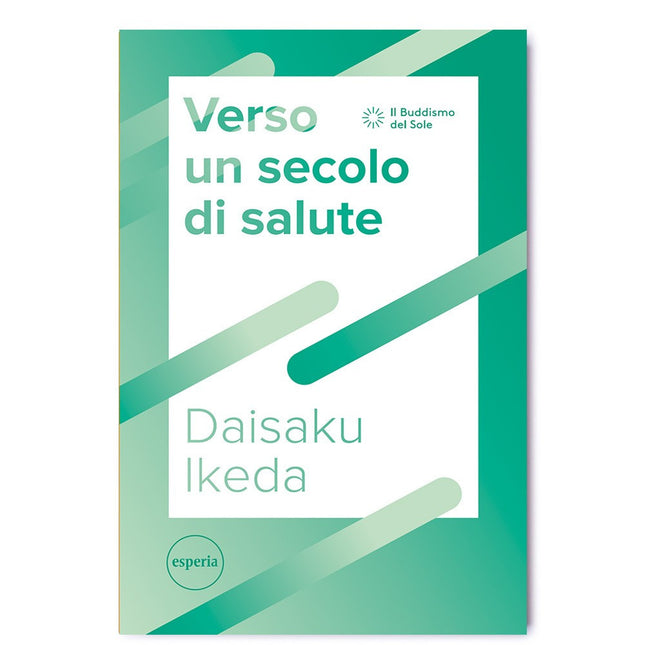
Esperia Towards a century of health
Daisaku Ikeda addresses the topic of health from a Buddhist perspective, sharing some important passages from Nichiren's writings. In the five lessons presented in this volume, taken from the series "Buddhism of the Sun," SGI President Daisaku Ikeda addresses the topic of health, sharing important passages from Nichiren Daishonin's writings from various perspectives. The author, starting from every person's desire to be healthy and live a long life, shows how the compassionate light of Buddhism can illuminate the darkness stemming from the sufferings of birth, aging, sickness, and death, and offer humanity the ability not to view illness with aversion but to consider it an integral part of the precious experience of being alive, an indispensable step on the journey toward happiness and the attainment of Buddhahood in this existence. In his lesson, Ikeda also clarifies that medical science and faith in Nichiren Daishonin's Buddhism are in no way contradictory. Because we embrace the great teaching of Nam-myoho-renge-kyo, there are no karmic sufferings that we cannot overcome. There is no need to worry or fear illness; what matters is our attitude, the way we face it. Daisaku Ikeda When we consider illness as one of the sufferings inherent in life, we can appreciate the true richness of the experience of living. Buddhism considers illness an innate part of life. When we fall ill, we understand how important and precious it is to be healthy, and we appreciate our life and our mission more. Furthermore, facing illness with strong faith and tenacious prayer, thereby developing a vast life-condition, instills courage and hope in those around us. In this way, illness becomes our mission. Daisaku Ikeda
€7,90
-

Esperia The Foundations of Happiness
Selected passages from Nichiren Daishonin’s writings for young women with commentaries by Daisaku Ikeda.This volume contains one hundred passages from Nichiren Daishonin’s writings, selected over recent years by the young women of the Soka Gakkai. Each passage is accompanied by a commentary by Daisaku Ikeda – president of the Soka Gakkai International and leader of the Buddhist movement based on Nichiren Daishonin's teachings – related to the topic discussed, thus offering readers clear guidance on how to apply the Daishonin's words in their own lives, as well as further insights by the young women of the Soka Gakkai International Study Department.“If you read and study Nichiren’s writings, you will become wise and develop a truly wonderful heart,” Daisaku Ikeda once told a young woman: this is the spirit that guided the editors in compiling the selection in the book, which, though easy to read, offers a broad vision of Buddhist principles capable of transforming life, becoming a source of inspiration and further study that will endure over time. "Make study your foundation!" This is an eternal guide for young women. Women who possess the bright mirror of Nichiren Buddhism in their hearts cannot be swayed by turbulent times nor defeated by adversity.Daisaku Ikeda
€15,90
-
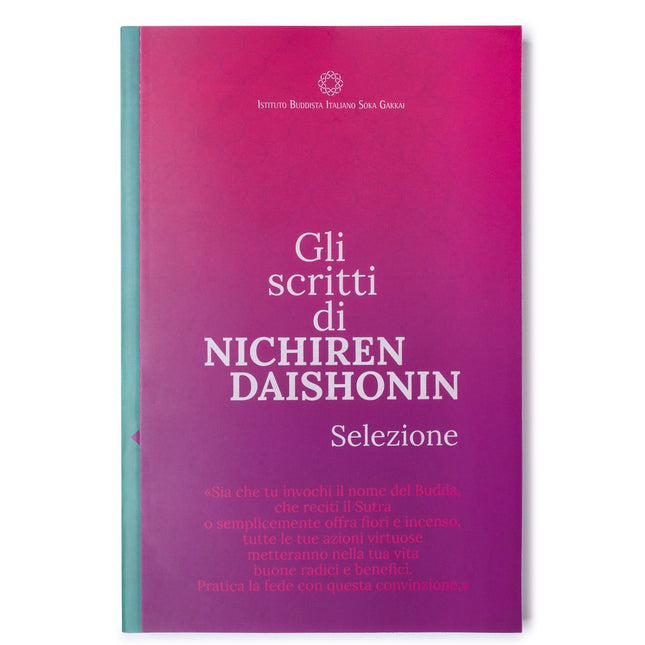
Esperia Writings of Nichiren Daishonin
This edition contains the most up-to-date translations of a selection of 45 writings by Nichiren Daishonin, chosen from among the most well-known and beloved. Millions of people have illuminated their lives by studying these texts. For a better understanding of the texts, a glossary of terms related to Buddhist doctrine has been added. A book that can be carried anywhere, also suitable for those approaching Nichiren Daishonin's Buddhism. Texts included in the volume: Attaining Buddhahood in This Lifetime A Ship to Cross the Sea of Suffering The Tatsunokuchi Persecution Lessening One's Karmic Retribution The Heritage of the Ultimate Law of Life The Treasure Tower Letter from Sado Delusions and Desires Are Enlightenment The True Aspect of All Phenomena The Practice of the Buddha's Teachings On the Buddha's Prophecy Reply to Kyo'o The Swords of Good and Evil The Difficulty of Sustaining Faith Letter to the Brothers Winter Always Turns into Spring Many in Body, One in Mind The Dikes of Faith Curing Karmic Illnesses The Three Obstacles and Four Devils Happiness in This World The Essentials for Attaining Buddhahood The Fourteen Slanders The Actions of the Votary of the Lotus Sutra The Eight Winds Admonition against Attachment to One's Fief The Real Aspect of the Gohonzon The Three Kinds of Treasure Letter to Misawa The Two Kinds of Faith Invisible Virtue and Visible Reward Flowers and Fruits The One Essential Phrase The Receipt of New Fiefs General Stone Tiger Extending One's Life Letter to Jakunichi-bo The Persecutions That Befall the Sage The Strategy of the Lotus Sutra The Dragon Gate Letter to Niiike The Person and the Law Great Evil and Great Good The Offering of Rice New Year's Gosho
€14,00
You have seen 60 out of 129 products